What Truly Makes Gym Equipment Commercial-Grade, Looks Strong and “Performs Right”
As a Buyer, we get Influenced with Cheap machine, Social Media Hype, China made looks and celebrity endorsement because being a human, A cheap price tag, a shiny look, a few reels with dramatic presentation, and a celebrity endorsement… and the decision is “done.”
The Real Cost of Cheap Commercial Gym Equipment: Hype vs. Biomechanics
As a buyer, it is incredibly easy to be influenced by cheap prices, social media hype, trendy imported looks, and celebrity endorsements. Because being human, a cheap price tag, a shiny look, a few reels with dramatic presentation, and an influencer validation are often all it takes to make the decision "done."
But here’s the uncomfortable truth:
Hype doesn’t protect joints. Looks don’t correct movement. Discounts don’t reduce breakdowns. “Viral” doesn’t mean “commercial-grade.”
In a high-traffic gym, the real cost of a cheap machine isn’t the invoice—it’s the injuries, the downtime, the maintenance headaches, and the members quietly quitting because the equipment feels wrong. The market is flooded with machines that look premium but move dangerously. In commercial fitness spaces, equipment isn’t judged by brochure specs. It’s judged every day by joint comfort, smoothness, stability, maintenance frequency, and whether the machine still feels new after years of continuous use.
This article breaks down what truly makes gym equipment world-class from five critical angles:
- Biomechanically perfect designing
- Testing & validating accuracy of biomechanics
- Finishing quality & aesthetics
- Durability for commercial abuse
- Low maintenance & high uptime
1) Biomechanics First: The Machine Must Respect the Human Body
Biomechanics isn’t just the "angle of a seat" or "range of motion." It’s the science of making the machine follow how the body is naturally meant to move—without forcing joints into unnatural paths.
A. Natural Joint Path (Not Forced Motion)
When a machine forces a path that doesn't match the user’s anatomy, the result is predictable: shoulder impingement in presses and flies, wrist stress in curls, knee irritation in leg extensions or hack movements, and hip discomfort in poor abductor/adductor designs. A well-designed machine allows the user’s joints to move in a safe arc with a stable structure.
B. Correct Resistance Curve (Strength Curve Matching)
Great machines don’t just add weight. They deliver resistance where the muscle can naturally produce force, and reduce it where joints are vulnerable. This means cam profiles or lever geometry are precisely aligned to the human strength curve, making it hard at the right point—not hard everywhere.
C. Adjustability That Actually Works
In commercial gyms, one machine must fit users from 5’0” to 6’5”, from beginners to elite athletes. Real adjustability is not just "more settings." It’s the right settings at the right ergonomic locations—easy to operate, highly visible, quick, and lock-safe.
2) Designing is Not Enough: Biomechanics Must Be Verified
Many brands design, but fewer validate. A machine isn’t proven in CAD software—it’s proven under real conditions. Gyms don't use equipment gently; members drop weights, slam stacks, sweat heavily, and adjust settings aggressively.
- Range of Motion Validation: A correct ROM must be full enough for muscle activation but limited enough to avoid joint strain across different body sizes.
- Alignment Markers & Setup Logic: On premium equipment, the user doesn’t guess their setup. There are highly visible alignment references (like matching the joint line to the machine's pivot point) and intuitive pin positions.
- Real-World Movement Testing: True validation includes repeated cycles of heavy use, vibration/noise audits, cable tracking checks, pivot wear monitoring, and stack impact checks. A biomechanically correct machine stays correct after thousands of repetitions, not just on Day 1.
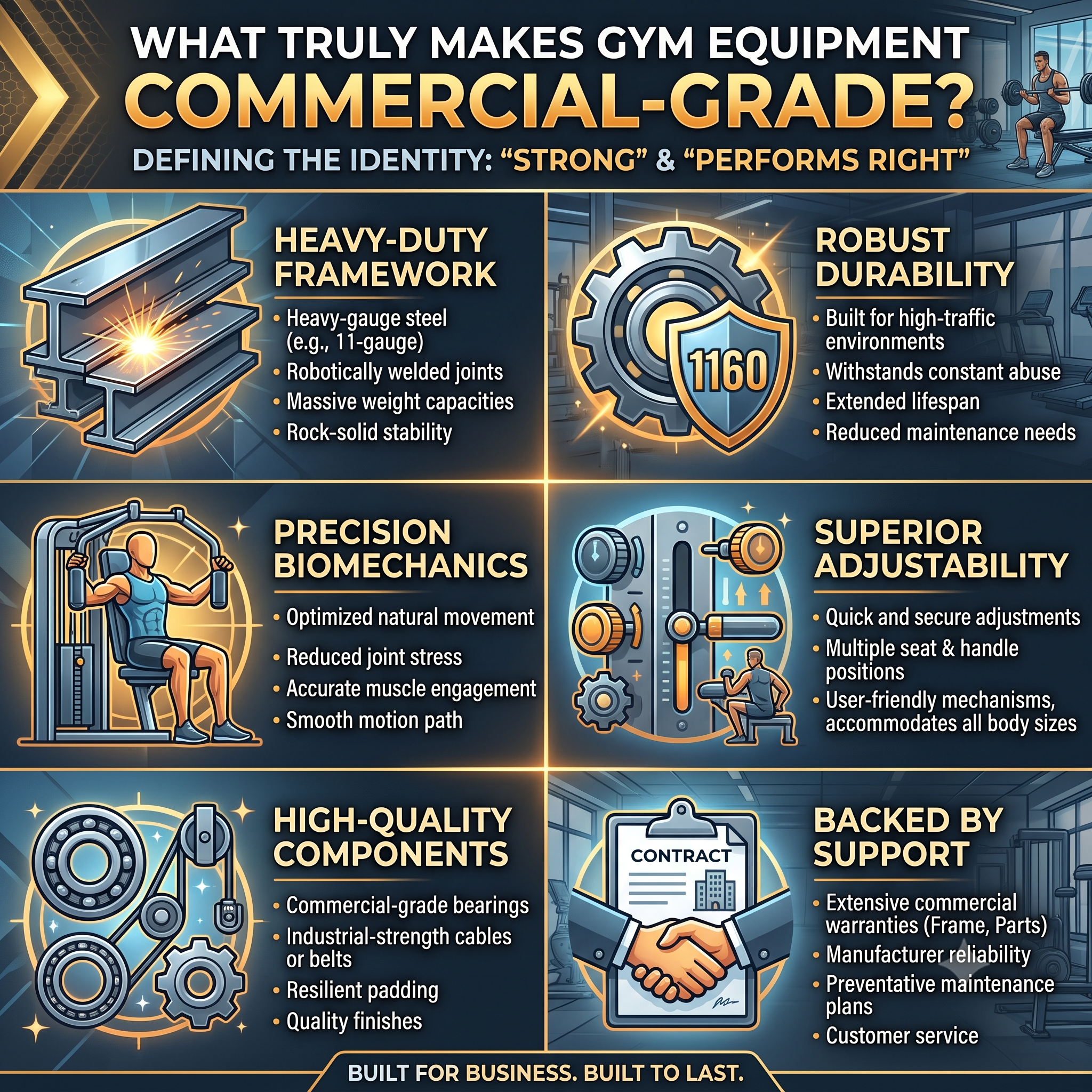
3) Durability for High-Traffic Commercial Use: Built for Abuse
Let's stop pretending. Commercial gyms are brutal environments. Cheap machines often win on Day 1 because they look shiny, but within 3 to 6 months of high traffic, the truth hits: wobble develops, noise increases, cables fray, pulleys misalign, and weight stacks start sticking.
True commercial durability requires engineering the real failure points:
- Frame Rigidity: Preventing structural flex. When frames flex, the biomechanics change and the machine stops moving in its intended path.
- Joint & Pivot Engineering: High-quality pivots, proper bushing/bearing selection, and correct spacing to reduce wobble and noise over time.
- Cable & Pulley Systems: Premium pulley alignment that eliminates rough motion and frequent, costly replacements.
- Reinforced Stress Zones: Added strength at high-stress areas like start/stop points, handle junctions, seat columns, and lever arms.
4) Finishing and Aesthetics: Premium Look is Business Value
In commercial gyms, aesthetics is not decoration—it is brand value. A machine can be biomechanically perfect, but if it looks dull, rusts, scratches easily, or feels rough, members lose trust. People don’t just train on equipment; they judge the gym by it, and they create social media content with it.
True premium finishing means meticulous surface preparation that resists corrosion, uniform coating consistency, clean weld lines, and high-quality upholstery that holds its shape and resists sweat wear.
5) Low Maintenance = High Uptime = Higher Profitability
Gym owners don’t just buy equipment—they buy uptime. Every machine with an "Out of Order" sign means lost member satisfaction, trainer frustration, and brand damage.
Low maintenance design is entirely intentional. It means featuring easily replaceable wear parts, serviceable cables without major disassembly, protected frames where sweat/water damage is common, and stable weight stack alignment to avoid plate clanking. A well-designed machine stays quiet and remains aligned even after months of rough commercial use.
What Smart Buyers Must Do (The Checklist)
If you’re buying equipment for a commercial gym, stop being influenced by what is trending on Instagram, celebrity photos, or simple "20% cheaper" price tags. Before buying any strength machine, demand proof of this simple checklist:
- Biomechanics: Joint-friendly path + proper ROM + correct pivot alignment.
- Stability: No wobble under load, no flexing in movement.
- Smoothness: Consistent resistance throughout the entire arc.
- Durability: Commercial wear design in cables, pulleys, pivots, and pads.
- Finish: Long-term corrosion protection + premium upholstery.
- Maintenance Ease: Service-friendly design + accessible wear parts.
Ask one powerful question: Will this machine still move the exact same way after 10,000 reps? If the seller can't answer that confidently, you are buying showroom furniture, not commercial-grade equipment.
Conclusion: Choose Wisely, Choose Bodytec
Your gym is a business, not a showroom. Think independently without outside influence and evaluate your equipment options logically on all parameters.
BODYTEC GYM EQUIPMENT is meticulously engineered to fit your highest expectations. We balance economic value with brutal commercial durability, minimal downtime, low maintenance, and responsive after-sales service.
To demonstrate our complete confidence in our manufacturing discipline—from initial design and testing to validation—BODYTEC offers a LIFETIME WARRANTY on machine frames. Invest in equipment that respects the human body and protects your business bottom line.
Tags: #GymEquipment #Biomechanics #FitnessBusiness #CommercialGym #StrengthTraining #QualityEngineering #Maintenance #GymOwner