Myth vs Fact: Steroids and Hormone for Bodybuilding -The Missing Link in Strength Training
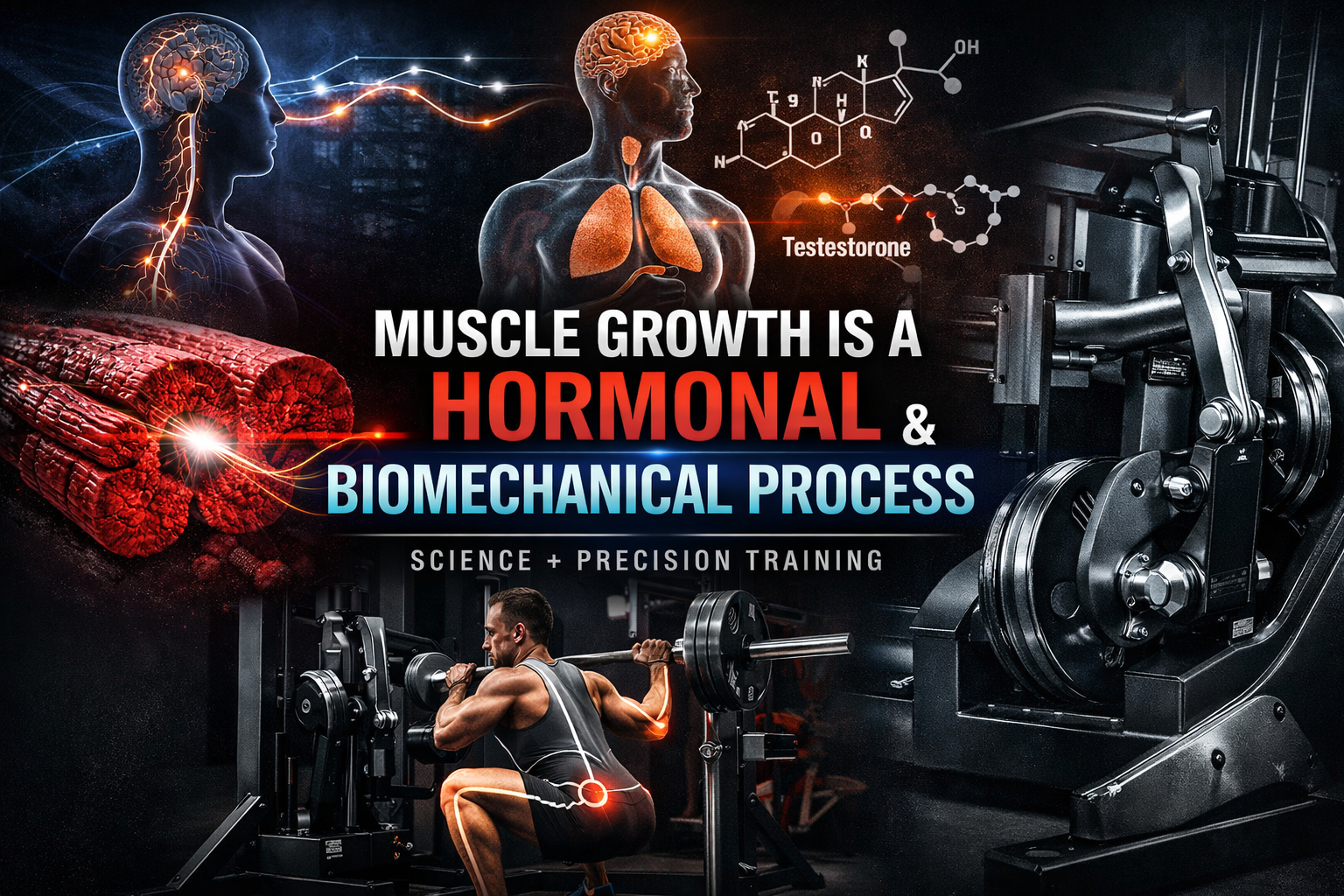
How Biomechanics Drives Hormonal Adaptation. Most people think muscle growth comes from lifting heavier. But real transformation happens when biomechanics and hormones work together. Every rep sends a signal to your nervous system, your muscles… and to your endocrine system.
Most people think muscle growth comes from lifting heavier.
But real transformation happens when biomechanics and hormones work together.
Every rep sends a signal to your nervous system, your muscles… and to your endocrine system.
The quality of that signal depends on how accurately the movement matches human biomechanics.
That’s why the equipment you train on matters more than most people realize.
Training Is Not Just Mechanical — It’s Hormonal
When you lift weights, you’re not only stressing muscle fibers, You’re activating the endocrine system-the body’s hormone network.
These hormones act like chemical messengers that tell your body:
Repair this tissue
Build this muscle
Mobilize this energy
Recover from this stress
In simple words:
Training stress → Hormonal response → Adaptation
No hormonal signal = no meaningful long-term adaptation.
Hormones Don’t Just “Float Around” -They Need Receptors
A key concept many people miss: Hormones don’t work unless the muscle has the right receptors.
Think of it as a lock and key system:
- Hormone = key
- Receptor = lock
Even if blood hormone levels are high, nothing happens without receptors.
The exciting part?
Resistance training can increase receptor sensitivity and number
meaning your muscles become better at responding to anabolic signals over time.
So, gains aren’t just about “more testosterone” …
They’re about better cellular responsiveness.
Big Lifts = Big Hormonal Signals
Not all workouts create the same endocrine response.
Training that involves:
- Large muscle groups (squats, deadlifts, presses)
- Heavy loads
- Multiple sets
- Moderate to short rest intervals
…tends to create stronger systemic hormonal responses.
This includes temporary increases in:
Testosterone, Supports anabolic signaling, recovery, and neuromuscular adaptations.
Growth Hormone (GH), Linked with tissue repair, collagen synthesis, and metabolic support.
IGFs (Insulin-like Growth Factors), Key players in muscle protein synthesis and remodeling.
But here’s the nuance:
Blood hormone spikes are signals, not guarantees of muscle growth.
The real adaptation happens inside the muscle cell.
It’s Not All Anabolic Stress Hormones Matter Too
Training also increases cortisol and catecholamines (adrenaline & noradrenaline).
These are not “bad” hormones.
They:
- Mobilize energy
- Support high effort performance
- Help the body deal with stress
Problems arise only when stress stays high without recovery. That’s when:
- Recovery slows
- Performance drops
- Injury risk rises
This is where smart programming and periodization protect long-term progress.
Periodization = Managing Hormonal Stress
Your body follows a classic pattern when exposed to training stress:
Alarm phase – Fatigue, soreness, stress
Resistance phase – Adaptation and performance gains
Exhaustion phase – If stress exceeds recovery
Good programming ensures you:
✔️Trigger enough stress to adapt
✔️Allow recovery so hormones normalize
✔️Avoid chronic overload that leads to burnout
This is why variation in load, volume, and rest periods is not just a performance tool — it’s an endocrine management strategy.
How correct Exercise on Biomechanically Accurate Equipment Helps?
Training is not just movement — it’s a biomechanical signal that triggers a hormonal adaptation cascade. Muscle growth doesn’t happen because you move weight. It happens because your body interprets those movements as stress worth adapting to it.
So the big questions are:
Are you sending the right stress signals?
Are you triggering the right hormonal responses?
Is the equipment you train on optimized for human biomechanics?
Movement with Purpose — Not Guesswork
Quality Signals Get Quality Hormonal Responses
Here’s the science behind it:
When you train:
✔Muscle fibers are loaded
✔Nervous system effort increases
✔Endocrine system releases hormones like
- Testosterone
- Growth Hormone (GH)
- IGF-1
But there’s a catch:
Hormones are only effective if the movement effectively engages the targeted muscles through a biomechanically accurate pattern.
Bigger Hormone Signals Through Smart Exercise Design, not all workouts create the same endocrine reaction.
Effective hormonal responses are usually linked to:
✔Exercises that recruit large muscle groups
✔Movements with mechanical tension
✔Controlled eccentric and concentric phases
✔Optimal force vectors
Recovery, Hormones, and Equipment Selection
Let’s be clear:
Hormonal stress isn’t bad — it’s necessary.
But chronic stress without recovery leads to:
❌Performance stagnation
❌Fatigue
❌Hormonal imbalance
❌ Risk of burnout
The Integrated Advantage
At its core, muscle growth is not just about:
❌Lifting heavy
❌More reps
❌Random training
It’s about:
Delivering the right biological signal
Stimulating hormonal systems optimally
Using tools that respect human biomechanics
Supporting recovery so adaptations stick
Your training is more than lifts and sets.
It’s a biological conversation between your muscles and your endocrine system.
To win that conversation, you need:
✔ Biomechanically accurate movement
✔ Efficient muscle recruitment
✔ Optimized hormonal response
✔ Tools that support quality training
Have you ever thought these points before selecting an Equipment for your Gym or Workout? BODYTEC equipment gives you exactly that.
When biomechanics and physiology are aligned that’s when transformation becomes not just possible, but inevitable.
BODYTEC Gym equipment ensures:
🟢Precise tension on target muscles
🟢Better muscle fiber recruitment
🟢Improved receptor engagement at the cellular level
BODYTEC equipment, on the other hand, is engineered to:
✔ Follow natural joint arcs
✔ Maintain optimal muscle tension
✔ Minimize stress on connective tissue
✔ Maximize functional recruitment patterns
This means your body receives a precise biomechanical signal that better triggers the hormonal adaptations necessary for strength, muscle growth, and performance.
This means your body not only gets the hormonal signal — it responds to it more effectively.
BODYTEC machines are designed around biomechanical principles that:
➡Optimize muscle tension curves
➡Maintain proper force vectors
➡Reduce unnecessary joint stress
➡Support higher-quality repetitions
The result?
🔥Higher-quality training
🔥Better neuromuscular adaptation
🔥Stronger hormonal responses
🔥Faster progression
BODYTEC equipment minimizes unnecessary joint and connective tissue stress, which means:
🟡You get the right training stress
🟡You recover better and faster
🟡You stay consistent longer
Consistency is where hormonal adaptation becomes permanent progress, not just temporary spikes.
BODYTEC Gym & Fitness Equipment is not just equipment.
It’s a training system designed around human physiology — the way your muscles, joints, nervous system, and hormones are meant to work because You are not just training muscles. You are training your endocrine system to support adaptation.
And when hormones, receptors, and correct biomechanics programming align — that’s when real transformation happens.
#Steroids #Hormone #Bodybuilding #BodytecFitness #Biomechanics #StrengthTraining #GymEquipment #FitnessInnovation #SportsScience
#ExercisePhysiology #StrengthAndConditioning #PerformanceTraining #GymOwners #FitnessBusiness #CommercialGym #MadeInIndiaFitness